


| Disclaimer: CD Child is just not knowledgeable tax companies firm. This text is just not tax, authorized, or accounting recommendation, and CD Child can not assure its info is correct. The aim of this text is to impart fundamental info on taxes as they relate to the music you create and your actions as a musician. This text is just not supposed to offer, and shouldn’t be relied on for, tax, authorized, or accounting recommendation. For recommendation pertaining to your tax scenario, please ask a tax knowledgeable. All the data on this article applies solely to people who stay and work within the U.S. |
It’s tax season. Should you’re an impartial artist incomes from streaming, stay exhibits, music publishing, and extra, understanding what and learn how to put together prematurely can assist you throughout tax time.
On this weblog, you’ll study the fundamentals of reporting music revenue, the commonest deductions for musicians, and greatest practices for holding clear and helpful revenue information.
Do I’ve to report revenue from my music?
We’ll begin with the fundamentals. Sure, you need to report your music revenue to the IRS. Whether or not it’s a money cost from a bar or royalties from streaming platforms paid by your distributor, all of it counts as revenue.
How do I report revenue from CD Child?
While you launch music with CD Child, you need to full a W-9 kind to obtain payouts (or a W-8 for those who’re a non-U.S. resident).
If you’re paid $10 or extra in income in the course of the 12 months, CD Child will concern a Type 1099-MISC to report this revenue to you and a replica goes to the IRS. Nonetheless, in case you are a non-U.S. resident and earned any US-source income in any respect from streams, you’ll be issued a Type 1042-S. Yow will discover extra associated info right here at our Assist Heart.
CD Child makes it easy to trace your earnings by means of the 12 months in our analytics dashboard. Should you’re a member, you may entry your dashboard right here.
The way you report your revenue from CD Child relies on whether or not you deal with your music as a pastime or a enterprise.
How do I do know whether or not my music is a enterprise or pastime?
In response to the IRS, a pastime is an exercise finished for sport, recreation, or pleasure — not for revenue. As a pastime, you may nonetheless generate significant revenue, however revenue is just not your finish objective. A enterprise, however, operates with the intention of creating a revenue. However it’s not this black and white.
To find out whether or not your music exercise qualifies as a enterprise, the IRS recommends contemplating a number of components — none of which solely classifies your music as one or the opposite. So it’s essential to have a look at the complete image and seek the advice of a tax skilled for those who’re uncertain.
- Whether or not you keep it up the exercise in a businesslike method and preserve full, correct books and information
- Whether or not you could have private motives for participating within the exercise
- Whether or not the effort and time you set into it counsel an intent to make a revenue
- Whether or not you rely upon revenue from the exercise to your livelihood
- Whether or not any losses are resulting from circumstances past your management or are typical in the course of the startup section
- Whether or not you or your advisors have the information wanted to run the exercise as a profitable enterprise
- Whether or not you’ve made a revenue in related actions previously
- Whether or not the exercise makes a revenue in some years (and the way a lot)
- Whether or not you may fairly anticipate future revenue from appreciation of property used within the exercise

What if my music is a pastime?
Should you decide your music is a pastime, you typically nonetheless should report your revenue in your tax return. Right here is extra info from the IRS on this.
What if my music is a enterprise?
Should you’ve decided that your music is a enterprise, you’ll seemingly must establish the construction of what you are promoting earlier than submitting taxes to precisely report your revenue and bills. Some widespread enterprise constructions for musicians are Sole Proprietorship, Partnership, and Restricted Legal responsibility Company (LLC). Please seek the advice of a tax advisor on what entity construction can be greatest fitted to you and learn how to precisely file your taxes below such construction.
What if I break up the revenue earned with collaborators (or bandmates)?
Music teams usually appoint one member because the unofficial supervisor and cash individual. If that’s you, likelihood is a payor like a music venue despatched you a W-9 to fill out for cost — adopted by a 1099 notifying you that revenue was reported to the IRS.
Whereas it’s straightforward for payors to do that, it’s inconvenient for the musician filling out the W-9 as a result of it seems like all of the income on the 1099 kind was earned by one particular person.
Please seek the advice of a tax advisor on how greatest to separate and report revenue with collaborators as every scenario is exclusive.
Greatest practices for monitoring your music revenue and bills
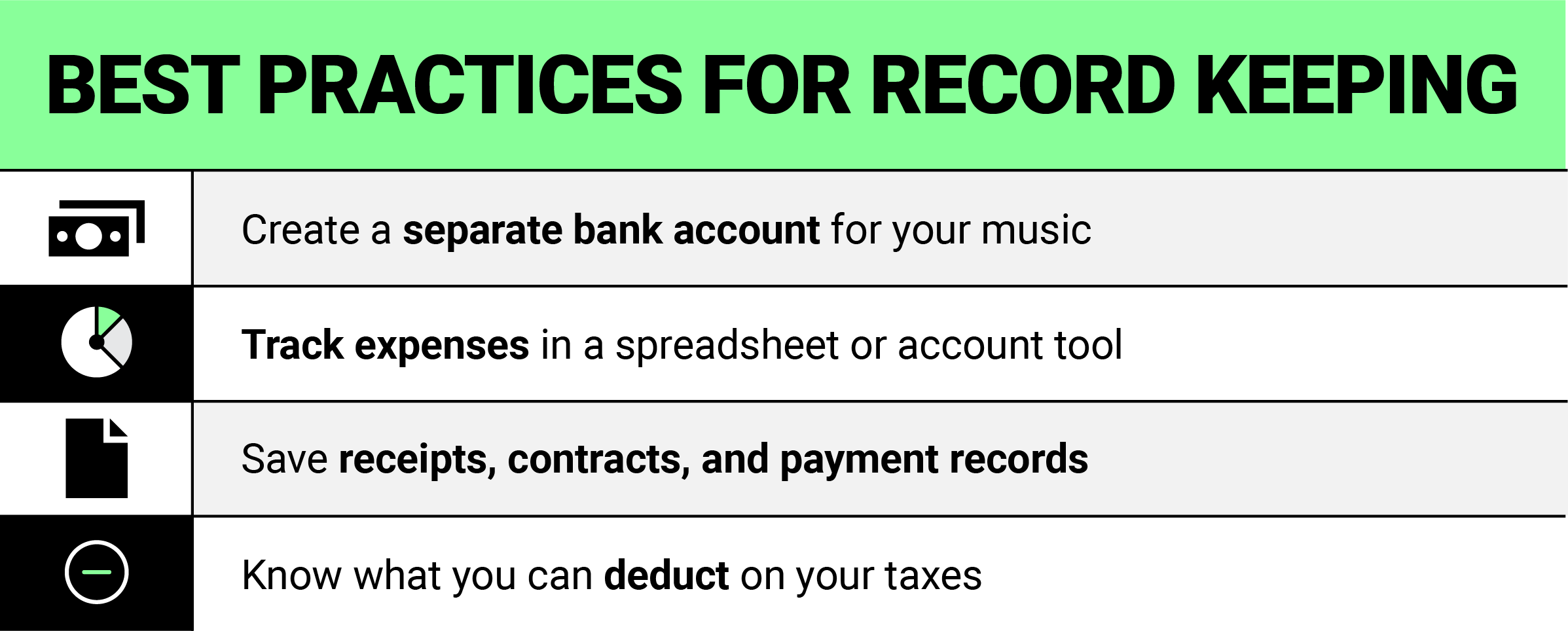
Preserve clear and correct information all year long. That info will turn out to be useful while you’re submitting your taxes. Listed here are a couple of greatest practices:
Preserve a separate checking account for music revenue: Consolidating your revenue and bills right into a single account will guarantee nothing will get misplaced.
Preserve a easy spreadsheet or accounting device: There are many accounting instruments on-line, however typically a easy spreadsheet documenting your revenue and bills is greater than ample.
Monitor mileage and meals on business-related journeys: Monitoring these bills in addition to car upkeep and repairs might turn out to be useful throughout tax time.
Save receipts for gear, advertising and marketing, and studio prices: This info can be essential for monitoring bills round your music as a enterprise.
Retailer copies of contracts and cost information: Having copies of how a lot you’ve earned and paid to collaborators is useful for verifying end-of-year paperwork is correct.
Widespread tax deductions for musicians
Up to now, we’ve lined learn how to report your music revenue as a pastime or enterprise, a little bit of the taxes and types concerned, and greatest practices for holding information. Now let’s have a look at widespread deductions that may cut back your taxable revenue. That is the place good record-keeping actually pays off.
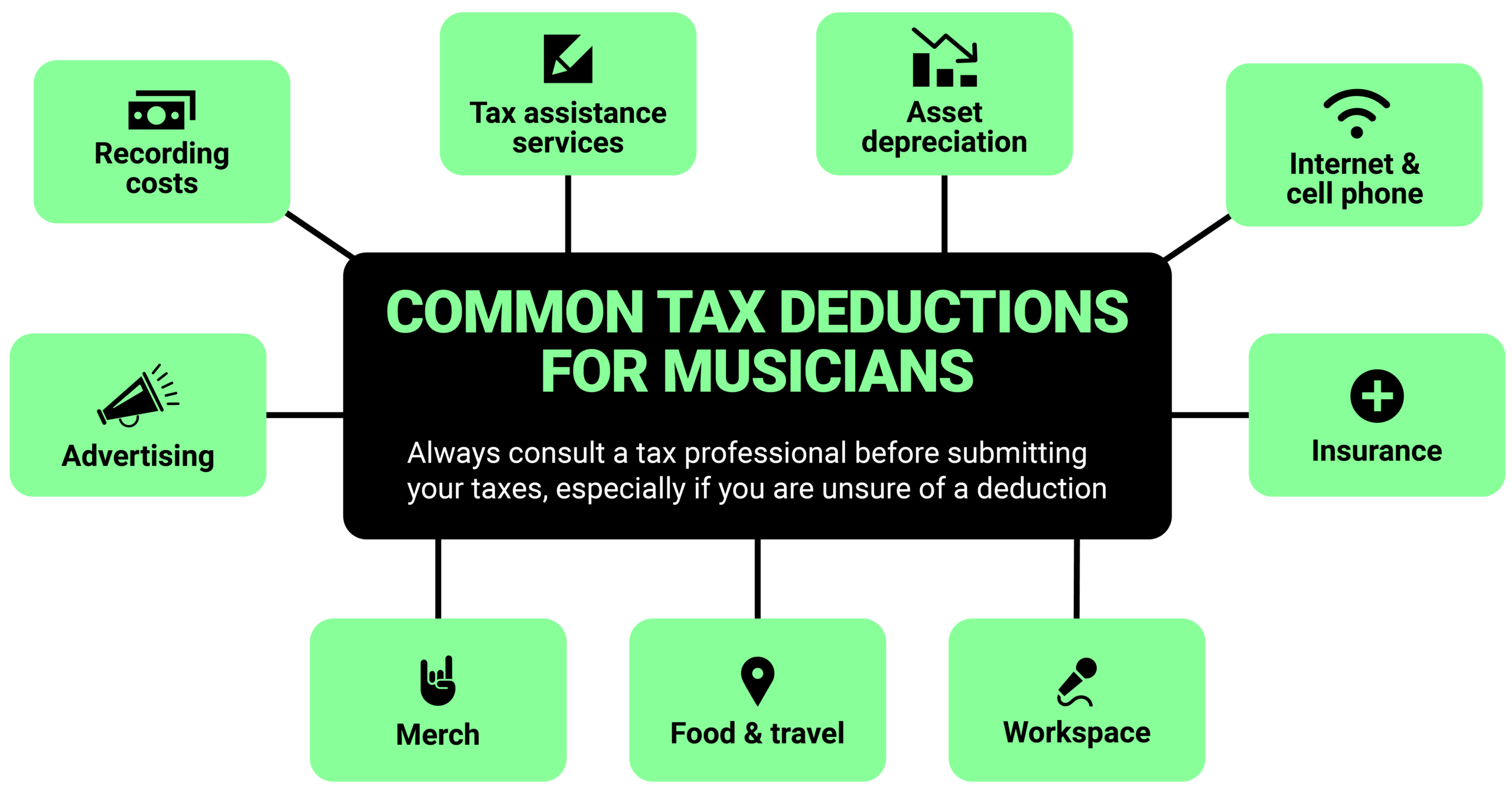
Musicians usually have distinctive enterprise bills, lots of which can be tax-deductible:
Recording prices: The Assist Impartial Tracks Succeed (HITS) Act handed in July of 2025 and should present helpful deductions for musicians. Seek the advice of together with your tax advisor to see the way you may profit.
Promoting: On-line advertisements, web site subscriptions, flyers, billboards, and different promotional prices could also be deductible.
Auto bills: Automobile repairs, upkeep and mileage could also be deducted on a cents per mile foundation. You’ll be able to study extra right here.
Meals: Meals whereas touring could also be deductible in the event that they meet IRS standards. Usually, 50% of qualifying meal bills could also be deductible. Study extra about enterprise journey bills right here.
Merch: Merchandise prices could also be deductible. It’s greatest to seek the advice of with a tax advisor on learn how to calculate these prices.
Residence workplace, apply area, or studio: You could deduct a portion of your housing bills for those who use a part of your own home solely for music work. You’ll be able to study extra right here.
Web or cellphone: Just like the sq. footage of your own home studio, determine what % of your Web use was to your music enterprise and these prices could also be deductible.
Insurance coverage: Gear insurance coverage and sure self-employed medical insurance prices could also be deductible.
Asset depreciation: Devices could also be depreciable property the place the depreciation expense could also be deductible. Seek the advice of together with your tax advisor on learn how to decide your depreciable property and associated depreciation bills.
Tax help companies: Should you rent knowledgeable to arrange what you are promoting taxes, a part of that value could also be deductible.
For essentially the most up-to-date info, overview the IRS sources on kind Schedule C and Deducting Enterprise Bills.
Conclusion
As an impartial musician, taxes can really feel like one more complicated system to navigate. However you may set your self up for achievement by holding detailed information of revenue and bills round your music. Bear in mind, when unsure, attain out to an authorized tax skilled and/or lawyer.
Should you’re a CD Child artist making ready for tax season, you may simply entry detailed details about your revenue and replace your tax info inside your account dashboard. It’s one among some ways we make it straightforward for musicians to handle their funds round their music. Create a free CD Child immediately to begin monitoring your earnings.


